
The Long Walk (by Richard Bachman)
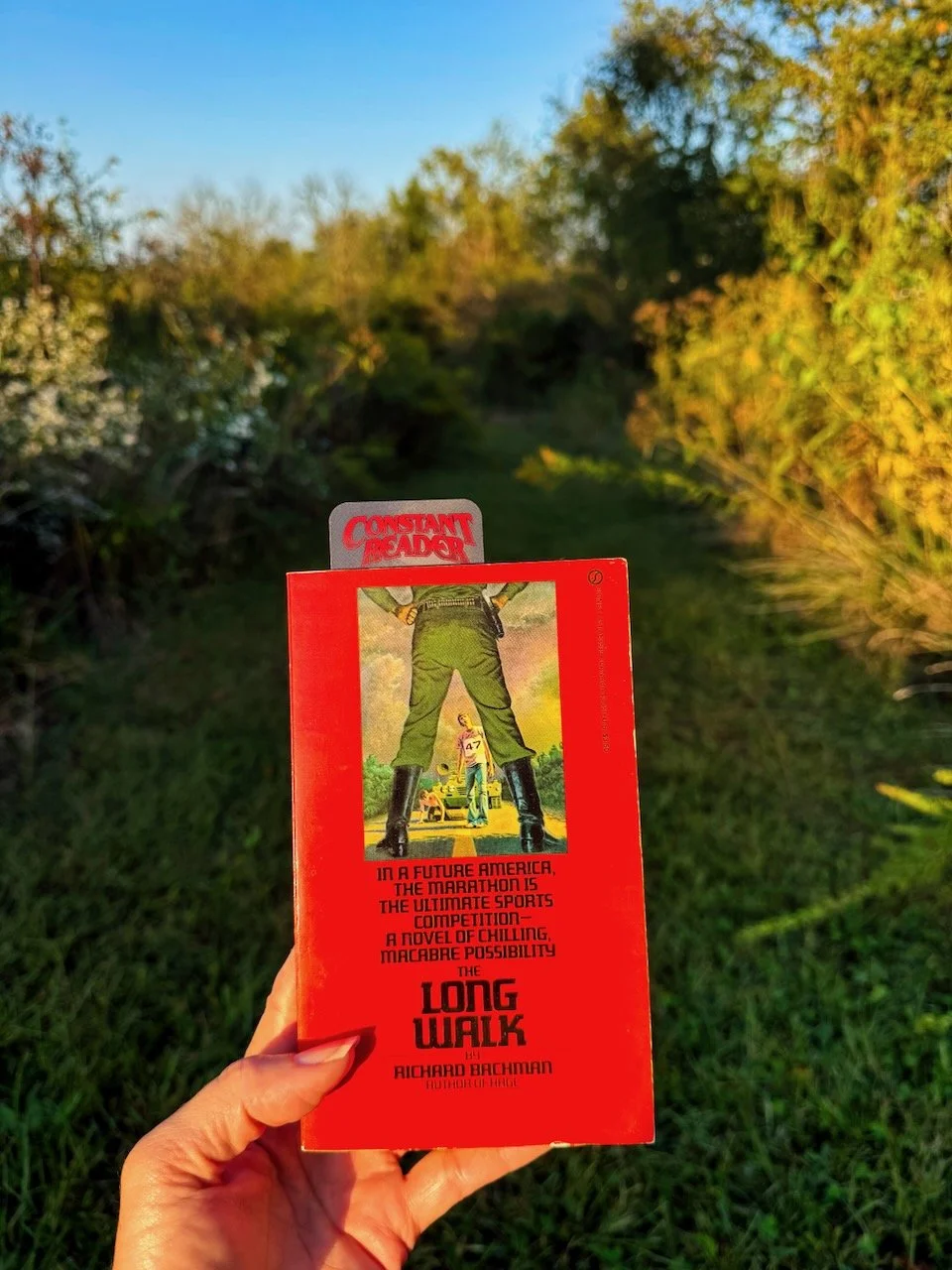
This is my second time reading “The Long Walk” by Richard Bachman, a pseudonym of Stephen King. I reread it because it’s the October selection for the in-person Constant Reader book club I belong to. It’s not a book I would have chosen to revisit. I first read it in 2017 and found it quite enjoyable. Although I remembered the general plot, I had forgotten the ending, so I didn’t mind picking it up again.
“The Long Walk” is a dystopian horror novel set in a totalitarian future America. One hundred teenage boys are chosen for an annual, grueling contest where they must walk continuously along a highway, maintaining a minimum speed of four miles per hour. There are no breaks, and the rules are brutal: fall below the speed or receive too many warnings, and you're out—permanently. The last walker standing wins a grand prize, but the physical and psychological toll is relentless. Through the eyes of sixteen-year-old Ray Garraty, the story explores themes of endurance, camaraderie, and the dark side of human nature in a chilling, minimalist narrative.
The downside of being in a book club is that I end up rereading books that I wish I had only read once. My initial impression of “The Long Walk” was much more positive than my thoughts on this reread. I believe that the first time I read the book, I was simply reading it as a fan of Stephen King and curious about the story. This time, however, I think I approached the book with a more critical mindset.
While reading the book, I couldn’t help but wonder about the reason behind these young men’s participation in this grueling journey. King never explicitly articulated the purpose of their adventure, leaving me to speculate on a few possibilities. The most apparent one was the “prize” of anything they desired for life. However, this notion didn’t seem particularly compelling to me. It simply didn’t make sense that such young men would willingly join this annual walk, knowing that death was the most probable outcome.
I also considered male bravado, as some characters clearly struggled with humility. However, this theory didn’t apply to all contestants. Each one believed they would win, but that’s still not enough of a reason to volunteer for this madness. I further contemplated their young age and the possibility that the boys may not have fully grasped the horror of the walk until they were in it. The reality of endless walking and death only occurred to them during the event.
Lastly, the dystopian setting, which suggested economic and social hardship, and the potential societal pressure from the boys’ hometowns were possibilities. King certainly emphasized the gruesome nature of residents venturing onto roadsides to witness the spectacle of the walk.
As I dissected the storyline for its purpose, I realized I wasn’t enjoying the effort I was putting into it. Even after considering these options as the reason behind this long walk, it wasn’t enough to make me buy into the plot a second time. The storyline felt weak, which left me feeling bored and eager for the walk to end. I’m all about creative and unrealistic storylines, but this time around, I just couldn’t care about “The Long Walk.” If I can’t understand the reason behind a story’s occurrence, it’s hard for me to have a positive opinion of it.
All I can say about the ending is that it left me feeling frustrated and confused.
On a positive note, I thoroughly enjoyed the diverse cast of characters. There were several likable characters, and I was genuinely rooting for the protagonist, Ray Garraty. It was fascinating to observe how their relationships evolved and deepened, particularly when Ray began to perceive his competitors as human beings. I appreciated the significant toll the walk took on the characters, both physically and mentally. King effectively made me empathize with the walkers. The contestants were the most compelling in a powerfully heartbreaking manner.
During discussions in the Constant Reader book club, I often attempt to help younger members comprehend the era in which King wrote a particular book, enabling them to grasp some of King’s character decisions in his novels. I sought a similar understanding for myself with “The Long Walk.” I discovered that King wrote this story in the late 1970s to somewhat emulate the era of the Vietnam War draft, where young men were compelled to face perilous obligations with limited options. Consequently, the walk’s voluntary nature is deceptive, as societal pressures, poverty, or propaganda might make it appear as the sole path for some. King may have employed this storyline to critique how systems exploit youth, with the boys’ motivations reflecting a blend of hope, naivety, and coercion.
Overall, I finished the book out of a commitment to the book club and a desire to learn how the book concluded, as I had forgotten. Clearly, my opinion of this book has diminished compared to my initial reading. The plot and ending are excessively ambiguous to my liking. In fairness, I believe I have made a reasonable effort to comprehend the story beyond its surface-level appeal. At least, I leave the story with a better understanding of its underlying purpose.
I’m aware that at our next Constant Reader book club meeting, my fellow book club members will be chuckling about the recurring King staples we’ve observed in the books we’ve read over the past year. These include chambray shirts, the frequent use of the phrase ‘whore master,’ and his penchant for mentioning juvenile bodily functions.
“The Long Walk” has been made into a movie, which is why our facilitator selected this book. Some of my fellow book club members have watched the movie and found it enjoyable, claiming that it closely follows the book. I’ve included a trailer for your viewing pleasure.
Feel free to explore my reviews of other Stephen King books below.
Different Seasons The Institute

As a participant in the Amazon Associates Program, I earn from qualifying purchases linked back to Amazon. Every penny earned allows me to blog about books and keeps this site running.
